
Introduction to Pappedeckel
Pappedeckel is a German word that refers to thick cardboard or pasteboard material commonly used for packaging, crafting, insulation, and protective layering. The term combines “Pappe” (cardboard) and “Deckel” (lid or cover), and traditionally described sturdy cardboard covers or protective layers. Today, Pappedeckel has evolved beyond its literal meaning and is widely associated with durable cardboard sheets used across industries.
From shipping boxes to beer mats, from school craft projects to industrial packaging solutions, Pappedeckel continues to play a silent yet powerful role in daily life. Its affordability, recyclability, and versatility make it an essential material in modern manufacturing and design.
This article explores the history, uses, environmental impact, cultural relevance, and future prospects of Pappedeckel while highlighting why it remains indispensable in both traditional and modern contexts.
The Origin and Historical Development of Pappedeckel
Early Beginnings of Pappedeckel
The concept behind Pappedeckel dates back centuries to the early development of paperboard in Europe. Germany, known for its strong printing and paper industries, played a key role in refining cardboard production techniques. During the 19th century, industrialization increased the demand for packaging materials that were lightweight yet strong.
As trade expanded, businesses required protective covers for goods. This led to the widespread production of thick cardboard sheets — what became known as Pappedeckel.
Industrial Revolution and Expansion
The Industrial Revolution significantly accelerated cardboard manufacturing. Factories began producing layered paperboard using mechanical processes, making Pappedeckel affordable and accessible. It was widely used for:
-
Book covers
-
Packaging for tools and machinery
-
Protective storage layers
-
Early advertising materials
By the early 20th century, Pappedeckel had become a standard industrial material across Germany and neighboring European countries.
Types of Pappedeckel Used Today
Although traditionally associated with thick cardboard sheets, modern Pappedeckel exists in various forms depending on application.
1. Solid Board Pappedeckel
This type is dense and compact, often used for:
-
High-quality packaging
-
Luxury product boxes
-
Hard book covers
-
Display boards
2. Corrugated Pappedeckel
Corrugated versions contain a fluted inner layer between two flat liners. They are widely used for:
-
Shipping boxes
-
Protective packaging
-
Storage cartons
3. Laminated Pappedeckel
This version includes a coated surface for:
-
Moisture resistance
-
Printing and branding
-
Decorative finishes
4. Recycled Pappedeckel
Produced from reclaimed paper fibers, recycled variants are eco-friendly and increasingly popular due to sustainability demands.
Industrial Applications of Pappedeckel
Pappedeckel in Packaging Industry
One of the most important uses of is packaging. Businesses prefer it because it is:
-
Lightweight yet durable
-
Cost-effective
-
Easy to customize
-
Printable for branding
From e-commerce shipping boxes to retail packaging, Pappedckel supports global trade.
Pappedeckel in Printing and Publishing
Hardcover books, folders, and archival storage materials often rely on strong cardboard sheets. provides rigidity and protection while remaining relatively lightweight.
Pappedeckel in Construction and Insulation
In construction, cardboard sheets serve as temporary floor protection or layering material during renovations. Although not a structural component, Pappedeckel acts as a protective barrier.
Cultural Significance of Pappedeckel in Germany
In Germany and parts of Central Europe, also carries cultural meaning.
One well-known use is in traditional beer halls, especially in cities like Munich. Here, thick cardboard beer mats are commonly referred to as Pappedeckel. These mats:
-
Protect wooden tables
-
Absorb moisture
-
Display brewery branding
During festivals such as Oktoberfest, millions of cardboard beer mats are used and recycled.
Interestingly, the term Pappedeckel is sometimes used humorously in everyday German language to describe something simple or basic — like saying something is “made of cardboard.”
Pappedeckel and Sustainability
Is Pappedeckel Environmentally Friendly?
Compared to plastic packaging, is considered environmentally responsible because:
-
It is biodegradable
-
It can be recycled multiple times
-
It decomposes naturally
-
It requires less energy to process than many plastics
Recycling Process
The recycling of cardboard involves:
-
Collection and sorting
-
Pulping with water
-
Removal of inks and adhesives
-
Reforming into new sheets
Many European countries, especially Germany, maintain advanced recycling systems that support circular use of Pappedeckel.
The Role of Pappedeckel in Modern E-Commerce
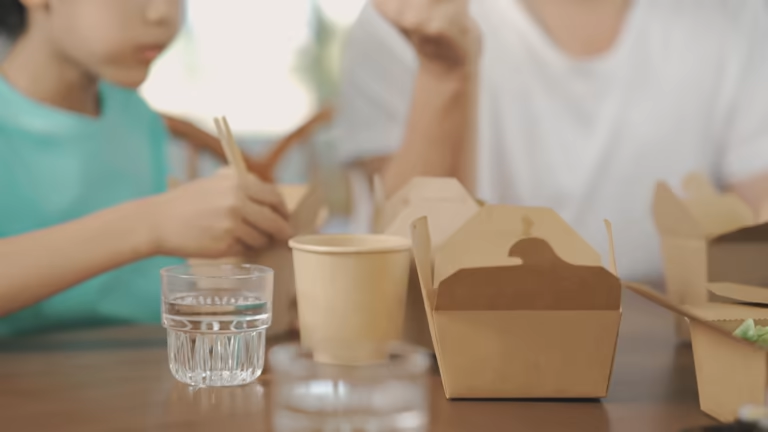
With the rise of online shopping, cardboard packaging demand has surged. Companies ship billions of packages annually, and serves as the backbone of this system.
Major online retailers rely heavily on corrugated cardboard for:
-
Product protection
-
Branding
-
Sustainable packaging strategies
The shift away from plastic fillers has further increased demand for recyclable cardboard inserts.
Pappedeckel in Creative and DIY Projects
Beyond industrial uses, is popular among artists and hobbyists.
Crafting and Education
Schools frequently use cardboard sheets for:
-
Model building
-
Science projects
-
Art displays
-
Prototyping
It is inexpensive, safe, and easy to cut or shape.
Architectural Models
Architects often use thick cardboard for building prototypes due to its:
-
Structural stability
-
Ease of modification
-
Lightweight nature
Technological Advancements in Pappedeckel Production
Modern manufacturing has improved the strength and functionality of cardboard materials.
Water-Resistant Coatings
Advanced coatings now allow cardboard to resist moisture, extending its lifespan.
Digital Printing
High-resolution digital printing enables brands to customize packaging with vivid graphics and QR codes.
Smart Packaging Integration
Some companies integrate tracking technology or smart labels onto cardboard packaging, blending tradition with innovation.
Economic Importance of Pappedeckel Industry
The cardboard manufacturing industry represents a multi-billion-dollar global market. Europe remains one of the leading producers.
Countries such as:
-
Germany
-
Austria
-
Switzerland
have well-established paper and cardboard industries.
The sector supports thousands of jobs in:
-
Forestry
-
Paper processing
-
Logistics
-
Recycling
Advantages of Using Pappedeckel
-
Affordable production cost
-
Easy customization
-
Lightweight yet strong
-
Recyclable and biodegradable
-
Wide availability
-
Safe for food packaging (when treated properly)
These benefits explain why cardboard continues to outperform many synthetic alternatives in various sectors.
Limitations of Pappedeckel
Despite its strengths, Pappedeckel has certain limitations:
-
Vulnerable to water damage (unless treated)
-
Limited load-bearing capacity
-
Can lose strength after repeated recycling
-
Not suitable for extreme environmental exposure
Understanding these limitations helps industries choose appropriate materials for specific uses.
The Future of Pappedeckel
The future of looks promising due to global sustainability trends. Governments worldwide are reducing plastic usage and encouraging recyclable materials.
Emerging trends include:
-
Bio-based coatings
-
Fully compostable packaging
-
Lightweight strength-enhanced boards
-
Carbon-neutral manufacturing processes
As environmental awareness increases, Pappedeckel is expected to remain a central material in sustainable packaging strategies.
Why Pappedeckel Remains Relevant Today
Despite technological advancements and the rise of alternative materials, maintains its relevance because it balances cost, functionality, and sustainability.
It supports:
-
Small businesses
-
Large-scale industries
-
Artists and educators
-
Environmental initiatives
Few materials offer such broad adaptability at such a low environmental impact.
Conclusion: The Enduring Value of Pappedeckel
Pappedeckel is far more than simple cardboard. It represents a versatile, sustainable, and economically important material that has adapted alongside industrial and cultural shifts. From traditional beer mats in Munich to modern e-commerce packaging across Germany and beyond, its presence is nearly universal.
As industries move toward greener solutions, Pappedeckel stands out as a material that combines practicality with environmental responsibility. Its recyclability, affordability, and wide-ranging applications ensure that it will remain essential in global markets for years to come.
In a world increasingly focused on sustainability and efficiency, proves that even the simplest materials can hold immense value.
Frequently Asked Questions (FAQs)
1. What does Pappedeckel mean in English?
Pappedeckel translates roughly to “cardboard cover” or “pasteboard lid.” It refers to thick cardboard sheets used for packaging, protection, and crafting.
2. Is Pappedeckel environmentally friendly?
Yes. Pappedeckel is biodegradable and recyclable, making it a more sustainable alternative to many plastic materials.
3. Where is Pappedeckel commonly used?
It is widely used in packaging, printing, education, crafts, beer mats, and protective shipping materials.
4. Can Pappedeckel be recycled multiple times?
Yes, but the fibers shorten with each recycling cycle. Eventually, new fibers must be added to maintain strength.
5. Is Pappedeckel waterproof?
Standard Pappedeckel is not waterproof, but coated or laminated versions can resist moisture and light exposure.